
Dear, Airbnb Superhosts: Don’t Rest on Your Laurels
Quick Summary: Airbnb Superhost status is valuable—but it’s not permanent, and platform changes can impact your bookings overnight. This blog shows how to future-proof occupancy by building demand outside Airbnb through a direct-booking website, strategic social content, and a steady system for earning Google reviews. With a simple funnel and 30-day plan, you can reduce platform dependency and keep your calendar full long-term.
Being an Airbnb Superhost feels like a moat around your business—higher trust, better conversion, and that little badge that signals “safe choice.” But here’s the uncomfortable part: Superhost status is not a permanent asset you own. It’s a label Airbnb awards, reassesses regularly, and can remove if your metrics slip—or if the platform changes what it rewards. Airbnb evaluates Superhost eligibility on a recurring cycle, and the standards are tied to performance over time, not your best season. Airbnb
That matters because the platform’s incentives can shift faster than your operations can. One algorithm tweak, one streak of mismatched guests, one unavoidable cancellation—and suddenly your “sure thing” looks a lot less stable.
One of our favorite examples of doing it the smart (and cautious) way is Uplifting Mansion—an awesome client that creates real, visible impact in their community. They’re a Superhost, but they don’t treat that badge as a business plan. Instead, they build demand outside Airbnb so the calendar stays full even when platform visibility fluctuates.
If you’re a Superhost who wants future-proof occupancy, here’s the practical playbook.
Why Airbnb Superhost status isn’t a safety net
Airbnb is transparent about one key point: Superhost is evaluated on a schedule, and it’s based on your recent performance window. That’s great for quality control, but risky if you’re leaning on the badge as your main demand driver. Airbnb
Here’s what makes it fragile in real life:
Performance is variable. Guest expectations change, markets shift, and one “bad fit” review can dent your average.
Platform priorities evolve. Even if your hospitality stays excellent, what Airbnb pushes in search can change.
You don’t own the relationship. Airbnb owns the traffic, the customer journey, and a big piece of the data.
Think of Superhost like a strong referral from a partner. Valuable? Absolutely. Permanent? Not guaranteed.
The real risk: platform dependency
If Airbnb is your only pipeline, you’re not running a marketing strategy—you’re renting one.
That’s why seasoned operators diversify. The goal isn’t to abandon OTAs. The goal is to make Airbnb one channel in a bigger system, not the foundation holding everything up.
A simple mental model:
Airbnb = demand you can lose
Owned channels = demand you can build
And your best “owned channel” is your website.
Don’t rely solely on Airbnb: your website is your safe haven
A direct-booking website isn’t about “going head-to-head” with Airbnb overnight. It’s about building a stable home base where:
You control the story (not just the amenities list).
You can capture leads (email/SMS) and bring people back.
You can rank on Google for terms Airbnb listings won’t consistently win.
You can build trust using reviews across the wider internet.
Also: Google explicitly references factors like relevance, distance, and “prominence/popularity” for local results, and reviews contribute to perceived prominence. Google Help
What your website should do (in plain terms)
Your website doesn’t need to be fancy. It needs to convert. Prioritize:
Fast mobile experience (most booking research happens on phones)
Clear “Book Now” and “Check Availability” buttons
A real differentiator (why your place, for this kind of trip?)
FAQs that reduce friction (parking, check-in, house rules, nearby attractions)
Trust signals: reviews, press mentions, community impact, safety info
The Uplifting Mansion approach (why it works)
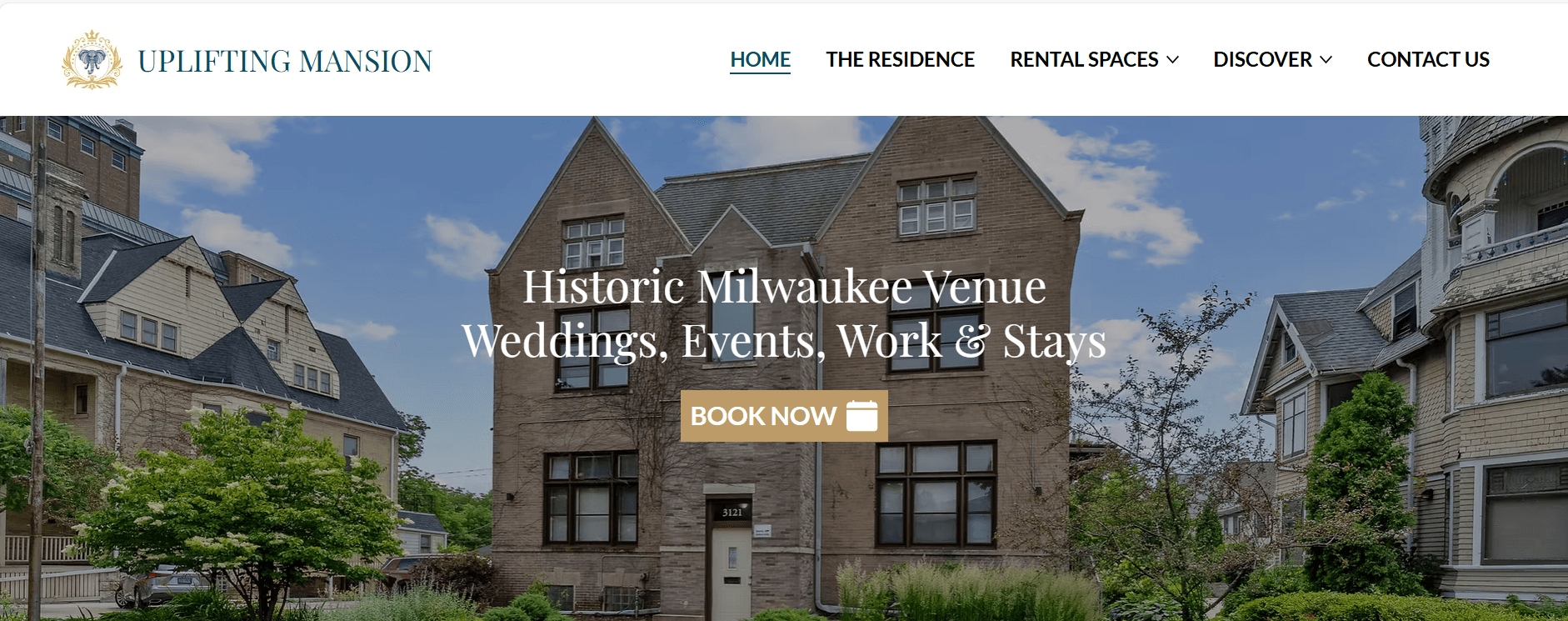
Uplifting Mansion doesn’t just “list a property.” They tell a story—who the place is for, what it enables, and how it connects to the community. That narrative works especially well on a website, where you’re not competing in a grid of thumbnails.
They treat Airbnb as one stream of bookings, while the website becomes the hub that supports everything else.
Social media management and content creation that actually fills dates
Social media won’t save a weak offer—but it’s powerful when it supports a clear funnel.
The mistake most hosts make is posting randomly:
pretty photos
occasional promos
no consistent message
no path to booking
A better approach is to build content around trip intent, not just your property.
Content themes that attract the right guests
Use rotating themes like:
“Plan your stay”: itineraries, weekend guides, best months to visit
“Inside the space”: room walkthroughs, amenities in use (coffee, pool, grill)
“Proof”: guest reactions, testimonials, before/after improvements
“Local connection”: partnerships, nearby businesses, community highlights
This builds trust and pre-qualifies guests before they ever click your listing.
Your posting goal isn’t likes—it’s clicks
Every week, you want at least a few posts that push people toward:
your website (availability page)
a “book direct” landing page
a lead capture form (for updates, specials, seasonal calendars)
That’s the difference between “branding” and “bookings.”
Google Reviews: the trust multiplier Airbnb can’t fully control
Guests don’t only search on Airbnb. Many search on Google first (“place to stay in ____”), then compare options.
And when they find you, reviews strongly influence confidence. BrightLocal’s ongoing consumer research shows how heavily people rely on online reviews in decision-making. BrightLocal
Travel-specific research also reinforces that reviews remain a major factor in booking confidence. MediaRoom
How to build Google reviews without being weird about it

Start with a simple, ethical system:
Deliver a consistent “review moment.” (welcome message + smooth check-in + one standout touch)
Ask at the right time. After checkout, when the guest is happy and stress-free.
Make it one-click easy. Send a direct Google review link.
Respond to every review. Short, warm, specific.
If you’re thinking, “But Airbnb guests won’t find my Google profile,” remember: Google reviews don’t only influence Google. They influence people, and people book where they feel safe.
Funnel your traffic through this: a simple system that keeps units full
Here’s a practical funnel that works for Superhosts who want stability:
Step 1: Attract attention (multiple channels)
Instagram/TikTok/Reels (awareness + intent content)
Google search (local SEO + travel keywords)
Partnerships (local businesses, wedding venues, tour operators)
Step 2: Send them to a controlled destination (your website)
Not your Airbnb listing first. Not your DMs. Your website.
Step 3: Convert or capture (two outcomes)
Your site should do one of these:
Convert now: direct booking inquiry / booking engine
Capture lead: email/SMS list for seasonal openings, promos, cancellation fills
A “lead capture” can be as simple as:
“Get the 2-day itinerary + best months to visit” (email required)
Step 4: Follow up like a real business
Once someone joins your list, you can send:
availability updates
seasonal guides
last-minute openings
repeat-guest perks
This is how you stop starting from zero every month.
Important note: Be mindful of platform rules and guest privacy. Don’t pressure guests or misuse contact info. Build your direct channel through your own marketing and guest-first relationships.
A practical 30-day plan for Airbnb Superhosts
If you want a realistic starting point, do this in the next month:
Week 1: Launch or improve your website’s core pages
(Home, Rooms, Location, FAQs, Contact/Book)Week 2: Set up your Google Business Profile + review request workflow Google Help
Week 3: Create 12 social posts from 3 content themes (plan, proof, local)
Week 4: Build one landing page + one lead magnet and start collecting emails
This isn’t “extra marketing.” This is risk management.
Conclusion
If you’re an Airbnb Superhost, you’ve proven you can deliver a great guest experience. But the badge isn’t a guarantee of future visibility, and it’s not something you truly control. Airbnb can reassess, the market can shift, and platform dynamics can change—fast. Airbnb
The safer path is diversification: treat Airbnb as one channel while you build an “owned” booking system through your website, intentional social content, and a steady stream of Google reviews. When you funnel traffic into a place you control, you’re no longer hoping the algorithm stays kind—you’re building demand that compounds.
If you want to go deeper, explore more resources on direct booking funnels, local SEO, and review systems—then implement one improvement at a time. That’s how Superhosts stay Superhosts… even if the badge disappears.
Want to scale your business through sales? Read these articles!
Marketing Rule of 7: The Power of Attention
Small Business Marketing Tips: Top of Funnel
Small Business Marketing Tips: Middle of Funnel
Small Business Marketing Tip: Bottom of Funnel